book review · Thinking, Fast and Slow
Thinking, Fast and Slow
2026-03-30 · 3 min read
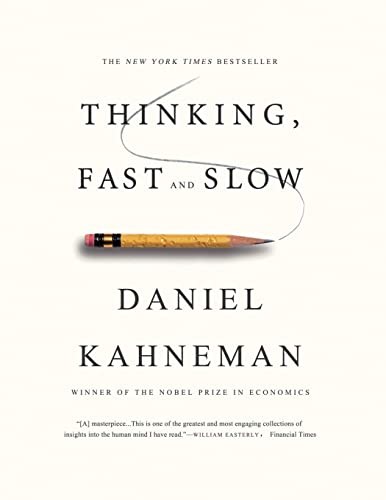
I’ll admit this took me longer than it should have, not because it’s badly written but because the print’s dense and some of the statistical sections genuinely require rereading a paragraph twice before it lands. That’s not a knock exactly, Kahneman’s disguising a lot of hard-won insight in prose that reads plainer than the ideas underneath actually are, and it took real concentration in stretches to make sure I wasn’t skimming past something load-bearing.
The System 1 and System 2 framing is the part everyone already knows secondhand, fast intuitive judgment versus slow deliberate reasoning, but the book earns that framework by walking through decades of experiments showing exactly where System 1 quietly hijacks decisions System 2 thinks it’s making. The anchoring effects, the availability heuristic, loss aversion, prospect theory, none of it is presented as trivia, it builds into a genuinely uncomfortable picture of how little control we actually have over judgments we’d swear were fully rational. I came away from this book noticing anchoring in real time, in a store, in a negotiation, in my own second-guessing, which is about the highest compliment you can pay a book like this.
Where it drags is in the back half, once the framework’s established the case-study chapters start to feel a little repetitive, more evidence for a point already well made rather than new ground. And I won’t pretend every section lands equally, some of the more technical statistics chapters are a genuine slog if that’s not already your background, a “sort of fight-flight response to the drier material” is about how it felt on my worse reading days.
Still, this is one of those rare popular-science books that actually holds up to the hype built around it. It won’t make you a rational agent, that’s kind of the whole point, nobody is one, but it’ll make you a more honest one about where your own certainty is coming from. Worth the slog.