book review · Anathem
Anathem
2026-04-30 · 3 min read
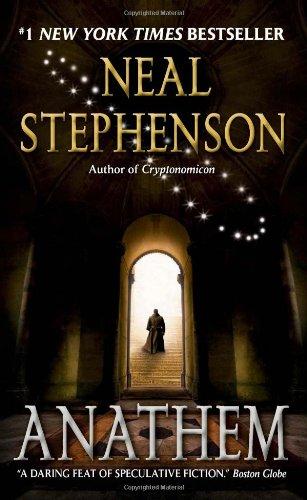
I wish I lived in a math. That’s not a typo, it’s the actual vocabulary Stephenson builds this whole book on, monastic enclaves of scientist-philosophers called maths, cloistered away from the “saecular” world outside their walls for years or decades or centuries at a stretch depending on which order they’ve joined. It takes real patience to earn that vocabulary. The first couple hundred pages are Stephenson building his invented language and his invented world brick by brick, and I won’t lie, there were nights I wanted to be past that part faster than the book was willing to let me.
Then it clicks, and once it clicks the back three quarters are as good as anything I’ve read from him. The central mystery, something has arrived in orbit and the maths are being called back into a world they were deliberately cut off from, unfolds at exactly the pace it needs to, and the extended philosophical arguments about consciousness, multiple worlds, and what math even is at the deepest level stopped feeling like homework and started feeling like the actual plot. There’s a real love story tucked into a monastic setting that shouldn’t have room for one, and Stephenson makes it land anyway.
He is, as more than one person’s put it, a polarizing writer, and I understand why. He’ll break every rule about show-don’t-tell and hand you a chapter-length infodump instead, because the ideas are the story here, not decoration around it. If you came to Stephenson through Cryptonomicon and wanted more of that book’s energy, this is a different animal, slower, denser, more interested in Fraa Jad’s theories than in a caper plot. But if you’re the kind of reader who’s willing to sit with an invented vocabulary until it starts making sense on its own, the payoff is real. My brain was still chewing on some of this book’s ideas weeks after I closed it, and that’s about the highest compliment I can give a book this demanding.