book review · Schild's Ladder
Schild's Ladder
2025-12-03 · 3 min read
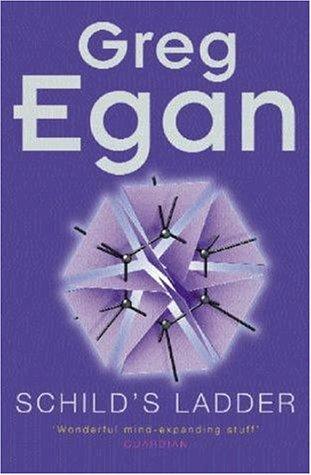
If you’ve heard the line that this is the hardest hard sci-fi novel ever written, I want to confirm that’s not hyperbole, and I say that as someone who reads a fair amount in this genre and considers myself reasonably comfortable with technical prose. Egan builds a far future where uploaded, functionally immortal humans wander a physics experiment gone catastrophically, elegantly wrong, a novel vacuum state expanding at half the speed of light and rewriting the rules of reality behind it, and he explains the exotic geometry and quantum mechanics underneath that premise in genuine, sustained technical detail. A physics degree would help. I don’t have one, and I felt every page of that gap.
Here’s the honest tension at the center of this book for me: the ideas are extraordinary, some of the most vivid, mind-expanding hard SF concepts I’ve read anywhere, and the execution asks a level of technical patience that regularly overwhelms the actual story trying to happen underneath it. Large stretches genuinely read closer to a physics lecture than a novel, and more than one stretch had me rereading a paragraph three times just to keep the concept in my head before the plot moved forward again.
Where the book does work, and works well, is in its quieter character material, the small cultural and interpersonal details of how post-human, effectively immortal people actually relate to each other and to a threat that might unmake them all. That’s the more sensitive, more approachable Egan showing through, and I found myself wishing there was more of that thread and less of the exacting multilinear algebra explaining exactly how the vacuum collapse propagates.
I don’t regret reading it and I understand why it has the reputation it does among hard SF loyalists. But I’d steer a first-time Egan reader toward something else first, this is a book for people who already know they want their science fiction to double as a physics seminar, and are fine with characters that stay a little cardboard next to ideas this dense.