book review · War and Peace and War
War and Peace and War
2026-03-22 · 3 min read
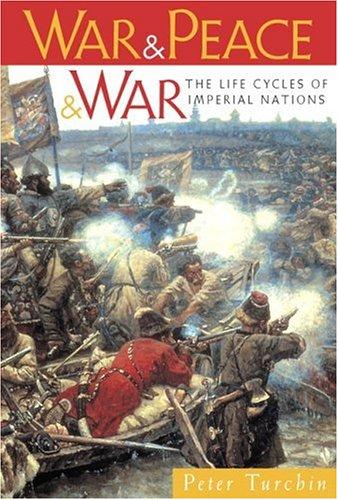
Peter Turchin is trying to do something that sounds almost impossible on its face, find actual laws governing why empires rise and fall, and he’s borrowed the term asabiya from Ibn Khaldun to name the thing he thinks is doing the real work, a kind of social cohesion or cooperative solidarity that forms hardest at the friction zones between hostile cultures. Frontiers make asabiya. Asabiya makes empires. And then, inevitably, comfort erodes it and the whole cycle resets.
The genuinely interesting parts of this book are the case studies he builds it on, Russian expansion into the steppe, Rome’s frontier wars, the long attrition of the Hundred Years War, and Turchin’s got a real gift for pulling out the centripetal and centrifugal forces holding a state together or tearing it apart. When he’s walking through a specific historical example his argument has real texture and momentum, freshly thought and genuinely wide-ranging the way a good survey should be.
Where this loses me is exactly where a skeptical reader would expect it to, in how confident the theory gets about itself. Alasdair MacIntyre made a pretty convincing case a while back that prediction in the strict social-science sense is impossible in principle, and Turchin’s own disclaimers about the limits of his model don’t quite match the certainty of his prose elsewhere. The book’s informal structure leaves real ambiguities unresolved, and I kept wanting the empirical rigor to catch up with how sweeping the claims were getting. Coverage skews hard European too, Rome and Russia get the bulk of the attention, and I’d have liked to see the theory stress-tested against empires outside that frame before being asked to buy in fully.
Worth reading if you want a genuinely different lens on why states cohere and collapse, asabiya is a useful concept even divorced from how far Turchin wants to push it as a law. Just don’t expect the rigor of the claim to match the confidence of the pitch.